

Jung & I
Relearning myself through MBTI—alphabet soup for the soul.

I recently revived my teenage obsession with the Myers-Briggs Type Indicator (MBTI). Often dismissed as pop psychology for high school girls and McKinsey consultants, it’s easy to write off as pseudoscience. But the deeper I went—especially into the Jungian theory beneath it—the more revelatory it became.
Like many, I began with a shallow understanding. I took the four-letter type at face value, interpreting my INFJ label as little more than “introverted intuitive feeler judger”—whatever that meant. With a bit more patience and curiosity, the MBTI piece-by-piece began to reassemble the parts of me that never seemed to fit together.
Why do I crave solitude and long to escape people, yet feel that my life’s purpose is to serve them? Why do I absorb others’ emotions like a sponge, yet think like a cold, calculating machine when I’m alone? Why do I feel disconnected from my body and the physical world, yet find my deepest joy in moments of full presence?
As I wrestled with these inner contradictions, I found an oracle in Carl Jung’s work—a framework both rational and embracing of my inner chaos. I hope it opens something in you, too.
Understanding Cognitive Functions
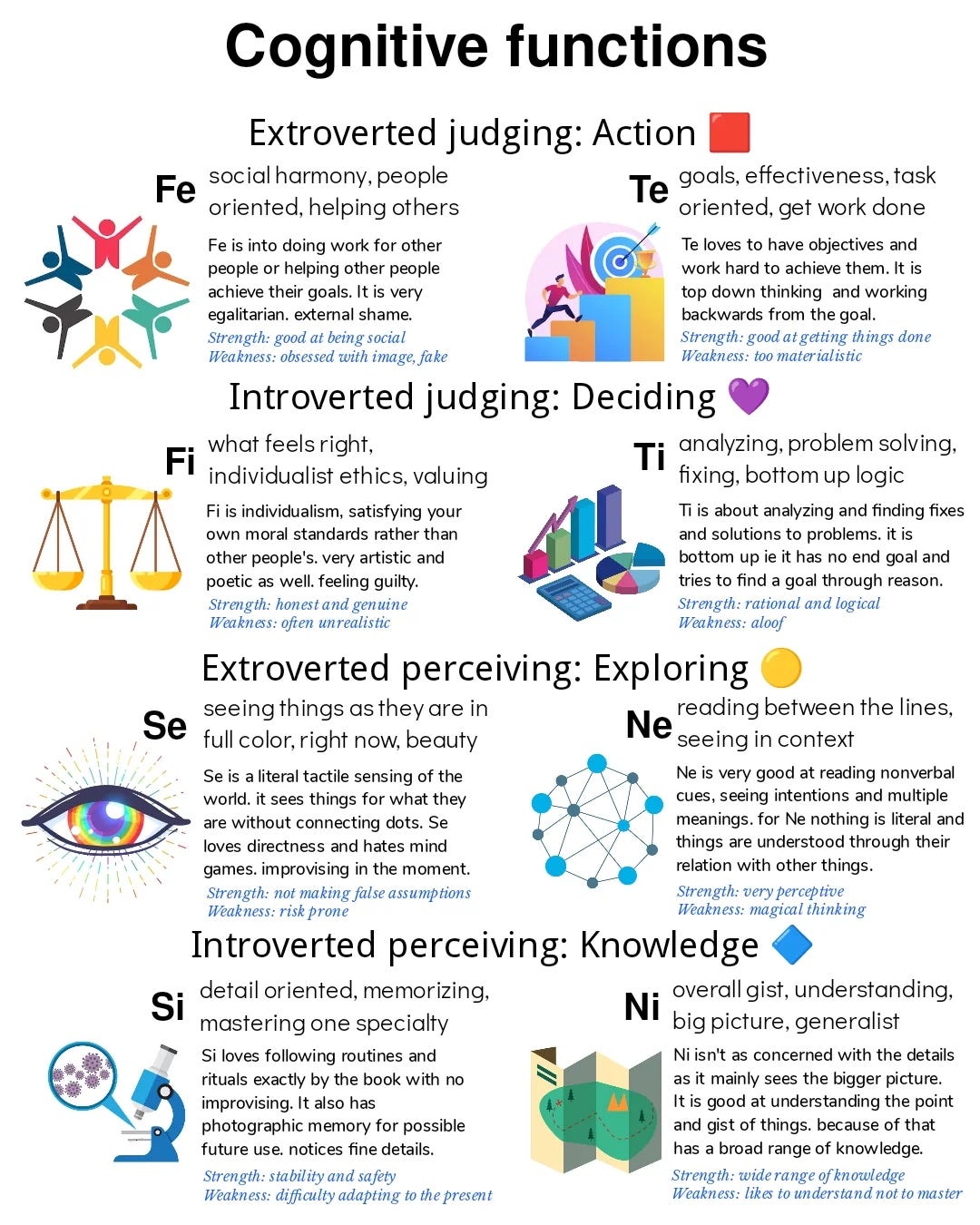
To truly grasp MBTI, we need to move beyond treating the four-letter types like alphabet soup recited by grade schoolers. Behind those acronyms (like ENTJ or ISFP) lies a system of eight cognitive functions—mental processes we all use, but in different orders and intensities.
Perceiving functions (how we gather information):
Introverted (Si) Sensing
Extraverted (Se) Sensing
Introverted (Ni) Intuition
Extraverted (Ne) Intuition
Judging functions (how we evaluate information):
Introverted (Ti) Thinking
Extraverted (Te) Thinking
Introverted (Fi) Feeling
Extraverted (Fe) Feeling
This model is rooted in the work of Carl Jung, one of the most influential psychological thinkers of the 20th century. Once a close collaborator of Freud, Jung eventually broke away to develop even more groundbreaking ideas—among them, the Collective Unconscious, Archetypes, Individuation, and Psychological Types which serves as the foundation of MBTI. He even coined concepts like introversion and extraversion—terms we now use so casually that their origins are often overlooked.
Jung didn’t just define introverts and extraverts by their social preferences. He offered a more nuanced distinction: introversion directs energy inward, toward the inner, subjective world; extraversion, outward, toward the external, objective world. Most people grasp that Thinkers and Feelers operate differently, what’s often overlooked is how radically distinct the introverted and extraverted expressions of the same function can be.
Take Extraverted Feeling (Fe) and Introverted Feeling (Fi), for example:
Fe orients toward the emotional needs of others, often prioritizing harmony, social cohesion, and external cues. Picture a gracious host who puts everyone at ease but often struggles to make personal decisions without the reassurance or guidance of others. Fe-dominant types—those with Extraverted Feeling as their primary function (ENFJs, ESFJs)—are attuned to group dynamics and can read a room effortlessly. Ironically, their empathy can leave them blinded to their own feelings.
Fi, in contrast, turns inward, centering on emotional authenticity and alignment with personal values. Fi-dominant types (INFPs, ISFPs) often appear quiet or mysterious, but their inner emotions run deep. Think of a moody artist unafraid to express their raw, unabashed emotions, even when it risks making others uncomfortable.
The Function Stack: Your Inner Operating System
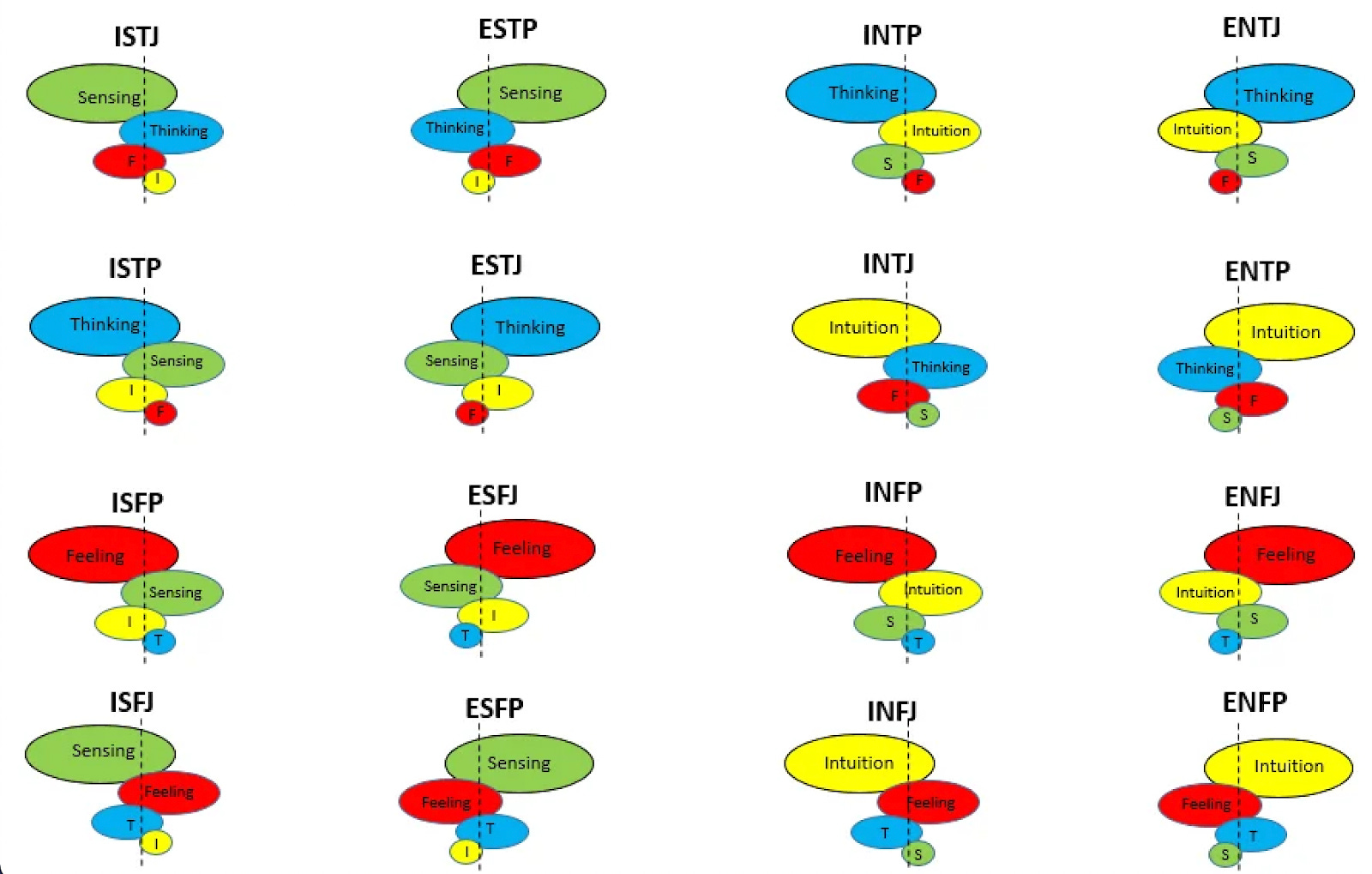
What differentiates each personality type is how the cognitive functions are prioritized and expressed. While everyone has access to all eight functions, the unique order in which they appear—known as the "function stack"—gives each type its distinct psychological flavor.
Here’s how the top four functions in the stack operate (we won’t be exploring the last four in this article):
Dominant Function (aka “Hero”) – Your psychological "home base." It's your strongest, most instinctive way of interacting with the world.
Auxiliary Function (aka “Parent”) – Supports and balances the dominant. It’s your secondary strength, helping you round out your perspective.
Tertiary Function (aka “Child) – A developing function. Often underused or immature until adulthood or later.
Inferior Function – Your weakest, least conscious function. Often feels like a blind spot or source of stress, but also holds the greatest potential for growth.
Dominant & Auxiliary Functions
Cognitive functions don’t operate in isolation—they work in tandem, shaped by their position in The Stack and their dynamic with others.
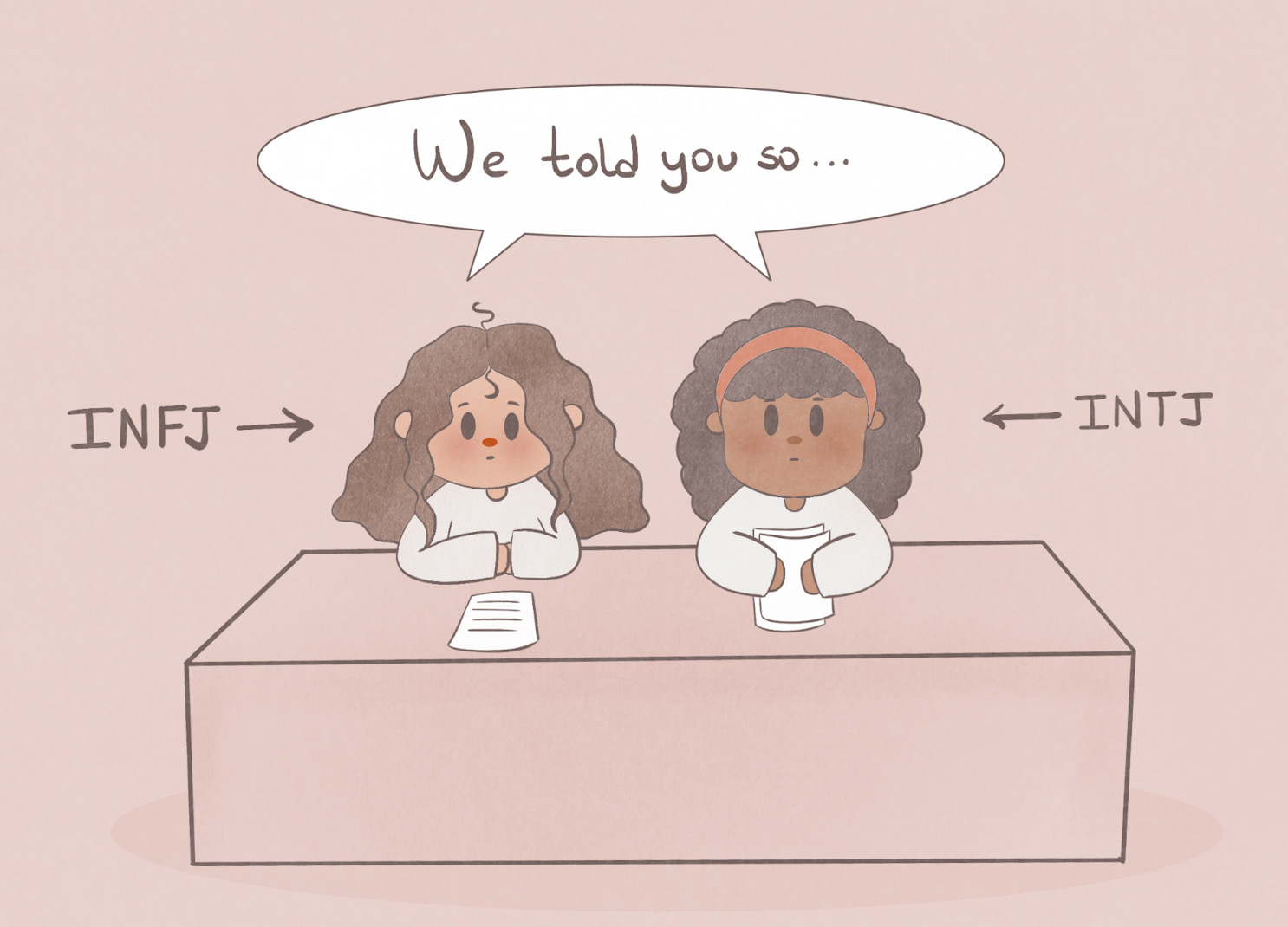
Take the INFJs and INTJs: both lead with Introverted Intuition (Ni), a function that excels at synthesizing patterns and projecting future possibilities. It can foresee the arc of a conversation or envision the trajectory of an entire society.
But Ni takes on very different flavors depending on the Auxiliary function that supports it.
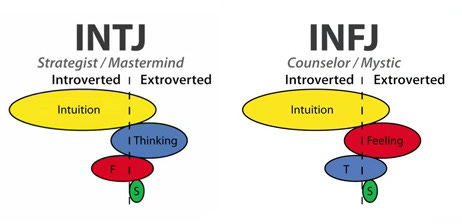
For INFJs, that support comes from Extraverted Feeling (Fe)—a function finely attuned to group harmony and emotional nuance. When Ni is filtered through Fe, it generates a visionary empathy—a drive to uplift humanity on a grand scale. Think of Simone de Beauvoir, articulating a moral framework for female liberation, Gandhi orchestrating a revolution through empathy, or even Carl Jung and his relentless quest to reach the depths of the human psyche with unsettling precision.
For INTJs, the Auxiliary Function of Extraverted Thinking (Te) takes Ni on a more pragmatic and results-driven path. Te is focused on external effectiveness—setting clear goals, building systems, and driving toward measurable outcomes. When paired with Ni’s foresight, this duo produces intensely strategic thinkers, capable of mapping long-range plans and executing with precision. It’s no surprise that figures like Elon Musk, Mark Zuckerberg, and Nikola Tesla are often associated with this type.
While both INFJs and INTJs share a desire to shape the future through their Dominant Ni, their approaches diverge. Fe, in INFJs, seeks to inspire and connect—winning hearts and minds through emotional resonance. Te, in INTJs, can command action with plans so meticulous, and ambitions so towering, that challenging their merits would seem irrational.
The Tertiary Function: The Inner Child
While the Dominant and Auxiliary functions shape the most visible aspects of personality, the Tertiary Function—often called the Child Function—reveals our inner contradictions and hidden motivations. Like the youngest member of a family, it acts playful and curious, yet it can also be reactive, naïve, and underdeveloped. Others may not encounter this “inner child” directly, but its influence on our desires is undeniable.
For INFJs, the Tertiary Function is Introverted Thinking (Ti)—a function concerned with internal precision and logical consistency, seeking objective truth independent of external influence. In dominant-Ti types like INTPs or ISTPs, it manifests as detached, analytical thinking that prioritizes logic above emotion.
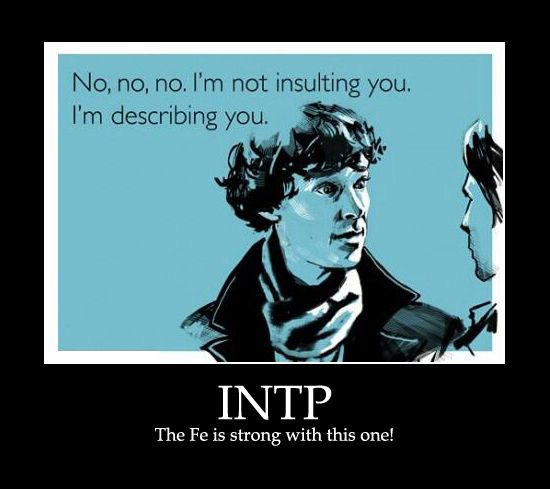
But in INFJs, Ti operates beneath the surface. Despite their outward warmth and empathy (via Auxiliary Fe) lies a surprisingly cold and surgical logic. Though their Ni–Fe pairing focuses on visionary ideals and collective well-being, INFJs crave an elegant, internally-consistent logic that supports their worldview.
A dramatic example of Ti in an INFJ gone terribly wrong is Adolf Hitler. His Introverted Intuition (Ni) produced a grandiose, absolutist vision of the future, rationalized through a morally corrupt ideological system (Ti), and framed as service to the people (Fe). This illustrates how immature Ti, when untethered from sound ethical grounding and unchecked by external criticism, can be weaponized to justify destructive ends.
For INTJs, the Tertiary Function is Introverted Feeling (Fi)—an inward-facing process concerned with emotional authenticity and alignment with one’s core values. It orients around questions like: What feels right to me? What do I believe in, regardless of what others think? It thrives in solitude, far from the influence of social expectations.
In contrast to INFJs—who hide a cold logical core beneath their empathetic exterior—INTJs, despite their reputation for being calculated, efficient, and even ruthless (via Auxiliary Te), often harbor a rich and emotionally charged inner world shaped by Fi. While they dedicate themselves to optimizing systems, streamlining processes, and executing future-oriented plans, their deeper motivation is often profoundly emotional.
Author and philosopher Ayn Rand offers a great example. Her philosophy of Objectivism champions reason as the sole means of understanding reality—rejecting intuition, faith, and emotion. On the surface, it appears to be a purely Te-driven framework: logical, systematic, and emotionally detached. But a closer look reveals just how deeply reactionary her views were.
Beneath the rationalist facade runs a powerful emotional undercurrent. Rand’s fierce rejection of collectivism stemmed from personal childhood trauma in Soviet Russia, where her family’s business was seized and individual ambition was crushed under communist rule. Her protagonists mirror this: though intellectual, they are passionate, unyielding, and emotionally volatile—not embodiments of cold logic, but a fiercely personal, morally charged sense of right and wrong, cloaked in the language of reason.

Inferior Function: The Ultimate Wildcard
The Inferior Function is the ultimate wildcard in our personality—a source of deep vulnerability and internal struggle, yet also the key to our greatest growth and fulfillment. It’s a part of you that often feels alien or even contradictory, a paradox embedded in the psyche. In ourselves, is both captivating and maddening; in others, alluring and off-putting. It acts as our blind spot, the place we instinctively regress to under stress. And paradoxically, the very function we must confront and cultivate to achieve real psychological balance.
For me, that function is Extraverted Sensing (Se).
Se is attuned to the physical world, taking in sensory details with clarity and precision. Se-dominant types (ESTPs and ESFPs) are often stereotyped as thrill-seekers drawn to physical adventure, adrenaline-fueled sports, and hedonistic indulgences. Their ease and fluidity in the physical world makes them natural athletes, performers, artists, and even military tacticians.
The irony of having Se as my inferior function is that I find myself oblivious of the physical world. I’m a certified klutz—a magnet for mysterious bruises. I lose things in plain sight, often panicking about my “missing” phone while holding it. Even basic sensory tasks like grocery shopping or taxes leave me short-circuiting. As for fixing things in the real world? No, thank you. I’d rather binge theoretical car mechanic videos than open the hood of my actual car.
Worse still, my coping mechanism for sensory overload is, ironically, more sensory input. I spiral into compulsive eating, shopping, and overindulgence in beautiful things—numbing myself to overstimulation with even more overstimulation. Like No-Face from Spirited Away, I’m left bewildered each time I resurface, suddenly aware of the self-destruction I’ve caused.
And yet, I experience my deepest peace in those rare moments when I am jolted into the present—when reality demands my full attention. Like when a violent ocean wave crashes into me and my surfboard, shattering any and all distractions of the mind. It takes an almost supernatural force to snap me into pure, unfiltered awareness.
It’s no coincidence that I’ve made grounding practices like yoga and meditation lifelong commitments. Obsession often begins with a yearning for something that comes effortlessly to others but maddeningly elusive to you. In my case, that something, apparently, is simply knowing that I’m holding my phone while I’m holding it.
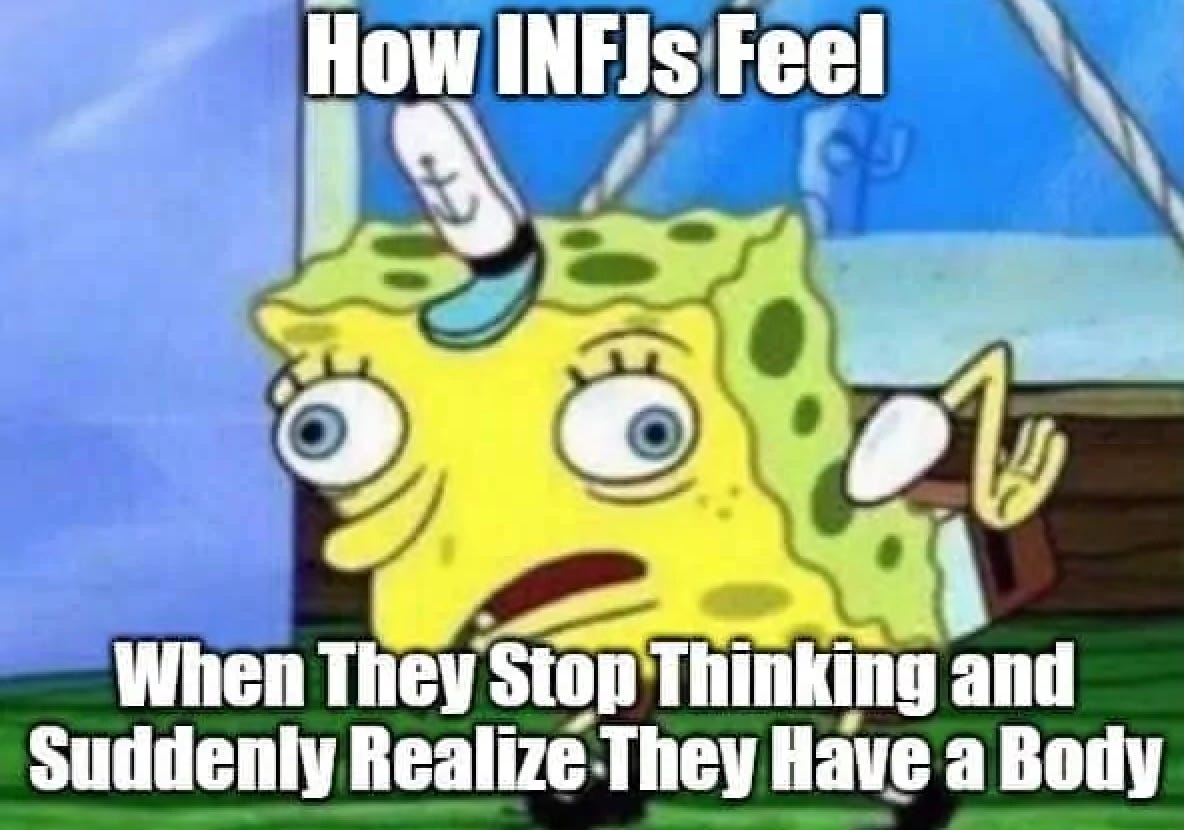
Though Jung never states it outright, I’d argue that his personality theory offers something paradoxical: an escape hatch from personality itself. These frameworks helped me understand how I’ve operated in the past and present. But with greater awareness of my current operating model, I feel more free to iterate on it—to move from unconscious habit to conscious choice. My Fe (Extraverted Feeling) may flinch, but I’ve been giving disagreeableness a try. Surprisingly liberating.
Bruce Lee famously said, “Be water, my friend,” to express his philosophy of The Way of No Way—a rejection of rigid adherence to any single martial arts style. Mastery, he believed, came through adaptability and openness, like water that takes the shape of whatever it flows into. Use what works; discard what doesn’t. There’s no absolute right or wrong—only what’s useful in the moment.
I believe the same holds true for personality. We all have natural dispositions and roles we assume in society, but nothing stops us from evolving beyond our default settings. With awareness, we can become more fluid, more intentional, more free.
So to the skeptics—is personality theory pseudoscience? Sure, if you expect it to spit out your destiny like a blood test. But if you treat it as a mirror, a blueprint, or a map, it becomes a tool for shedding old narratives and authoring the new ones you could become.
We live in an era where a lot of subjective experience has been pushed out of mainstream (western) science in terms of reductionism and empiricism for centuries. It's funny because for many, something like InsideOut is a much better, accessible models of emotions or inner working than anything else they've been taught. So I agree about some important insight about people being relegated to "pseudoscience" areas, no less a contested space for neuroscience and tenuous relationships between actual modern applications for phenomenology.
I wonder if you've looked into enneagram or socionics, among some other theories, too.
this made me question my entire existence as an infj and now i am a shell of who i was